Home

Search Keyword

find Search our site:


Today

Link Icons

Orthodox Church in America

The Orthodox Church Newspaper

Diocese of New York and New 
Jersey

Orthodox Christian Mission Center (OCMC)

FOCUS NORTH AMERICA


Internet Radio


Orthodox Christian Network 
Orthodox Music Player Button

ARK Button

Anchor - Orthodox Talk Radio


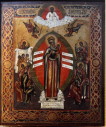
Welcome to the official website of the Orthodox Church of the Mother of God, Joy of all the Sorrowful, founded in 1966

We are a small parish in the Diocese of New York and New Jersey, of the Orthodox Church in America (OCA).
We are in historic Mays Landing, New Jersey, easily reachable near where Route 40 meets Route 50 in Atlantic County.

Street address:joy

Church of the Mother of God
115 Hudson St.
Mays Landing, New Jersey 08330

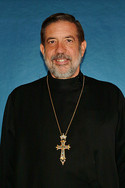
Our Rector, Rev. Boris Slootsky

2B Pembrooke Lane
Manchester, New Jersey 08759

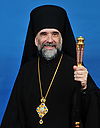
Our Bishop, The Right Reverend Michael

Bishop of New York and the Diocese of New York and New Jersey.

Our Primate, The Most Blessed Jonah

Archbishop of Washington, Metropolitan of All America and Canada


Nativity of the Theotokos

By Fr. Thomas Hopko


In addition to the celebration of the Annunciation, there are three major feasts in the Church honoring Mary, the Theotokos. The first of these is the feast of her nativity which is kept on  September 8.

The record of the birth of Mary is not found in the Bible. The traditional account of the event is taken from the apocryphal writings which are not part of the New Testament scriptures. The traditional teaching which is celebrated in the hymns and verses of the festal liturgy is that Joachim and Anna were a pious Jewish couple who were among the small and faithful remnant-"the poor and the needy"-who were awaiting the promised messiah. The couple was old and childless. They prayed earnestly to the Lord for a child, since among the Jews barrenness was a sign of God's disfavor. In answer to their prayers, and as the reward of their unwavering fidelity to God, the elderly couple was blessed with the child who was destined, because of her own personal goodness and holiness, to become the Mother of the Messiah-Christ.

Read more...
 

Elevation of the Cross

By  Fr. Thomas Hopko

The Elevation of the Cross, celebrated on the fourteenth of September, commemorates the finding of Christ's Cross by Saint Helen, the mother of the Emperor Constantine in the fourth century; and, after it was taken by the Persians, of its recovery by the Emperor Heraclius in the seventh century at which time it was "elevated" in the Church of the Resurrection in Jerusalem. From this latter event the "universal elevation" of the Cross was celebrated annually in all of the churches of the Christian Empire.

The day of the Elevation of the Cross became, as it were, the national holiday of the Eastern Christian Empire similar to the Fourth of July in the United States. The Cross, the official emblem of the Empire which was placed on all public buildings and uniforms, was officially elevated on this day by the bishops and priests. They blessed the four directions of the universe with the Cross, while the faithful repeated the chanting of "Lord have mercy." This ritual is still done in the churches today after the solemn presentation and elevation of the Cross at the end of the Vigil service of the holy day following the Great Doxology of Matins.

Read more...
 

The Lord is my Shepherd

By Archbishop Dmitri of Dallas and the South


Psalm 22/23 which begins with the words, “The Lord is my Shepherd,” is probably one of the best known, most often quoted and memorized of all David’s beautiful hymns. It has always occupied an important place in the spiritual life of the Orthodox Christian, and is one of the Psalms included in the order of preparation for the reception of Holy Communion.

In the early Church the catechumens, especially as the time for their baptism drew near, were made familiar with its contents and were even obliged to learn it by heart. It seems, however, that its meaning was not fully explained to them until after they had received the grace of the All-holy Spirit in the mysteries of baptism, chrismation and the eucharist.

“We gave you the Psalm, beloved children who hurriedly approach the baptism of Christ, so that you might learn it by heart. But, it is necessary, because of its mystical, hidden meaning, that we explain it to you, with the light of divine grace.” (From a sermon attributed to St. Augustine.)


Read more...
 

Prayer is essential to Christian life.

by Fr. Thomas Hopko

Prayer is essential to Christian life. Jesus Christ himself prayed and taught men to pray. No one who does not pray to God can be a follower of Christ.

In the Orthodox Church all prayer is Trinitarian. We pray in the Holy Spirit, through Jesus the Son of God, and in his name, to God the Father. We call God "our Father" because Jesus has taught us and enabled us to do so. We have the capability of addressing God as Father because we are made sons of God by the Holy Spirit (see Rom 8).

Read more...
 
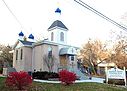
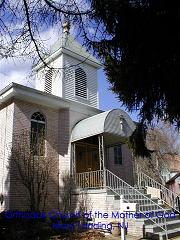
Photo of our Church

Our Church Building

Our church building, and the services celebrated within it, are from the tradition of the church, from the vision of St John the Apostle, as well as the Old Testament Temple. The interior of the Orthodox Church buildings are particularly styled to give the experience of the unity of all things in God. They are not constructed to reproduce the upper room of the Last Supper, nor to be simply a meeting hall for men whose life exists solely within the bounds of this earth. The church building itself, is an Icon of the world.

Read more...
 

Who Gave Us the New Testament?

by Fr. A. James Bernstein

"The history of early Christianity clearly reveals that God used His Church, composed of flesh-and-blood Christians, as active participants in the process of selecting and establishing the New Testament canon, just as He used real people —with feelings, emotions, unique backgrounds and perspectives—to write the twenty-seven separate books."
Sometimes it is easy to overlook the obvious. Take, for instance, the New Testament. Even though every Christian really knows better, it is easy to forget that the New Testament was not written as one continuous book. Rather, it is a collection of twenty-seven shorter writings which were penned by a variety of authors at differing times and geographical locations and compiled much later. Nowhere in the New Testament do we find a list of what books belong in the New Testament. The “canon” of Scripture is, of course, not “scriptural.”

This brings up anther important question which may not be so obvious. Who, then, decided which books should be included in the New Testament canon and which ones left out?
Read more...
 

Purpose

As the local community of the Church of the Mother of God, this parish, exists for the purpose of worshiping God according to the Holy Scriptures and Tradition of the Holy Orthodox Church, to encourage union with God among the members of the parish, to seek out the lost, the searching, and the un-churched and to strive to bring them into union with the Church, to provide religious education to its members and potential members, provide charitable aid, and to defend, promote, and witness to the Orthodox Christian Faith in southern New Jersey.
This website is a tool to help in this purpose. Primarily to publicize our existence in southern New Jersey, and hopefully, encourage people to "come and see". The many pages on this website contain information we hope is helpful.
Read more...