
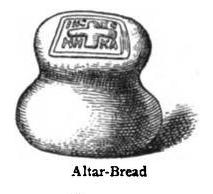
Offering Prosphora
In our parish, small prosphori (offering breads) are available at the candle stand for the faithful to offer in remembrance of the living and the departed. Before the Divine Liturgy, you may take a prosphoron and submit it to the altar along with a list of names for the priest to remember in prayer.
During the Proskomedia, the service of preparation celebrated before the Divine Liturgy, usually while the Hours are being read, the priest commemorates the names on each list. As he prays for each person, he removes a small particle of bread from the prosphoron and places it on the diskos (paten), near the Lamb—the central portion of bread that will be consecrated as the Body of Christ during the Divine Liturgy. In this way, the living and the departed are remembered in prayer as the Church prepares for the celebration of the Holy Eucharist.
If you are unable to offer prosphora before the Divine Liturgy, you may request it at Vespers on the preceding evening or at the conclusion of the previous Sunday’s Liturgy.
After the Divine Liturgy, the prosphoron is returned to the person who offered it. You may notice small portions of bread have been removed as the priest commemorated the names you submitted.
This practice has its roots in the early life of the Church, when the faithful brought bread and wine to be used in the celebration of the Divine Liturgy. Although the offerings are now prepared in a more customary way, they remain a meaningful expression of our love for God and our concern for one another.
The prosphoron returned to you has not been consecrated as the Body of Christ. Rather, it is part of the antidoron, the blessed bread distributed to the faithful at the conclusion of the Divine Liturgy. The word antidoron means “instead of the gift,” referring historically to the bread given especially to those who had not received Holy Communion.
The prosphoron offered for the commemoration of names is also a form of antidoron. It is a beautiful custom to share this bread with the person or persons for whom it was offered. This can be especially meaningful when they are homebound, ill, or otherwise unable to attend church and receive the Eucharist. In this simple act, we share not only bread, but also the love, remembrance, and prayers of our parish community.